

How Much More Fake Makeup Is Being Sold Graph
18 March 2019 - Trade in counterfeit and pirated goods has risen steadily in the last few years – even every bit overall trade volumes stagnated – and now stands at 3.iii% of global trade, co-ordinate to a new report past the OECD and the EU'due south Intellectual Property Office.
Trends in Trade in Counterfeit and Pirated Goods puts the value of imported fake goods worldwide based on 2016 community seizure information at USD 509 billion, upwards from USD 461 billion in 2013 (2.5% of world trade). For the European Matrimony, apocryphal trade represented half-dozen.8% of imports from non-European union countries, up from five% in 2013. These figures exercise non include domestically produced and consumed fake goods, or pirated products being distributed via the Internet.
Trade in simulated goods, which infringe on trademarks and copyright, creates profits for organised crime gangs at the expense of companies and governments. Fakes of items like medical supplies, car parts, toys, food and cosmetics brands and electrical goods carry a range of health and safety risks. Examples include ineffective prescription drugs, unsafe dental filling materials, fire hazards from poorly wired electronic appurtenances and sub-standard chemicals in lipsticks and infant formula.
"Counterfeit trade takes abroad revenues from firms and governments and feed other criminal activities. It tin also jeopardise consumers' health and safety," said OECD Public Governance Manager Marcos Bonturi, launching the report with the Director of the EU Observatory on IPR infringements at the EUIPO, Paul Maier, and the EU Ambassador to the OECD Rupert Schlegelmilch. "Counterfeiters thrive where there is poor governance. It is vital that we do more to protect intellectual property and accost corruption."
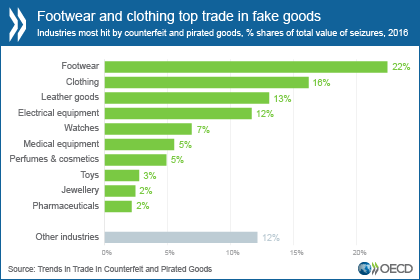 The goods making upwards the biggest share of 2016 seizures in dollar terms were footwear, article of clothing, leather goods, electric equipment, watches, medical equipment, perfumes, toys, jewellery and pharmaceuticals. Customs officials likewise noted an increase in counterfeits of goods less ordinarily seen in the by such as branded guitars and construction materials.
The majority of fake appurtenances picked up in community checks originate in mainland People's republic of china and Hong Kong. Other major points of origin include the United Arab Emirates, Turkey, Singapore, Thailand and India.
The countries near affected by counterfeiting in 2016 were the U.s., whose brands or patents were concerned past 24% of the false products seized, followed past France at 17%, Italy (fifteen%), Switzerland (xi%) and Germany (9%). A growing number of businesses in Singapore, Hong Kong and emerging economies like Brazil and Prc are also becoming targets.
Modest parcels sent by post or express courier are a prime and growing conduit for counterfeit goods. Small parcels accounted for 69% of total customs seizures by volume over 2014-2016 (57% via post and 12% via courier), up from 63% over the 2011-2013 period.
Along with bereft screening of small parcels, other areas where policy gaps are facilitating counterfeit trade are inconsistent penalties on traffickers and the special rules governing free trade zones. Past OECD-EUIPO analysis has shown that free trade zones – where economical activity is driven past reduced taxes, customs controls and lighter regulation – tin can unintentionally facilitate counterfeit trade. The OECD is working with its fellow member countries on formal guidelines to help authorities stem the problem.
Trends in Trade in Counterfeit and Pirated Goods covers all physical fake appurtenances which infringe trademarks, design rights or patents, and tangible pirated products, which alienation copyright. It does not include online piracy, which is a farther bleed on economies.
For further information, or to speak to one of the authors of the written report, please contact Catherine Bremer in the OECD Media Office (+33 ane 45 24 fourscore 97).
Working with over 100 countries, the OECD is a global policy forum that promotes policies to improve the economic and social well-being of people around the world.
Source: https://www.oecd.org/newsroom/trade-in-fake-goods-is-now-33-of-world-trade-and-rising.htm
Posted by: hendersonsuese1976.blogspot.com
0 Response to "How Much More Fake Makeup Is Being Sold Graph"
Post a Comment